Saturday, October 6, 2012

Pullet Surprise: My New Chickens

Since I've decided to get into the egg selling business, I needed a few younger chickens since most of my layers are on the old side. I didn't have much hope of finding laying hens at the swap, though. Or any hens at all--- I've noticed a lot more roosters for sale than hens. But I went anyway.

The first seller with some possibles had these two pullets (young hens) and wanted $5 each for them, which I thought was real reasonable. She then mentioned they were Araucanas--- well, Ameraucanas, anyway. I bought them both. (Ameraucanas and Araucanas are two breeds that lay blue-green eggs.)

Another seller had some Golden Campines which were pretty but not what I wanted. Then I noticed some birds in another of that seller's cages. He said they were Welsummers--- another breed I like, which lays dark brown eggs. He quoted a price of $5 a bird but gave me a deal for taking them all. These chickens also were from this year. I got a rooster in this group which is nice so I can hatch out replacements.

The pullets all went in the pen with the older laying hens. The Welsummer rooster, who I named Kellogg, got put in the pen with my poultry odds-and-ends. My Chocolate turkey, Imelda, took one look at Kellogg and fell in love.  (She's almost invisible behind a clump of weeds.)


Kellogg was a bit nervous to have such a large female interested in him, so he distracted himself with the grain pan. The girls, meanwhile, had to cope with sharing space with my really old Old English hen. Sadly, one of the pullets was doing poorly and died, but the others are adapting well to their new home, and when I went out at ten to turn off their light, I saw that all were inside the shelter of the calf hutch.

Sunday, September 23, 2012

Fun at the Fur and Feather Swap/Swap Schedule

Saturday, Sept. 22, 2012, I got up early to get my act together to go to the Stephenson Fur and Feather Swap.
I did not have much for sale as I didn't raise much poultry this year. Mostly I had sheep--- 5 Shetland ewe lambs. And some sheep skulls for Halloween decorations. I also had a cage full of kittens who needed new homes. I also took along a Shetland Sheep sign that normally is in my yard when I have sheep for sale. I believe signage is important at such events because some people may be shy about asking questions.
After I got set up but before the swap officially began, I looked around at the other swappers' stuff. First stop was to look at Mr. Damron's Boer and Nubian goats.
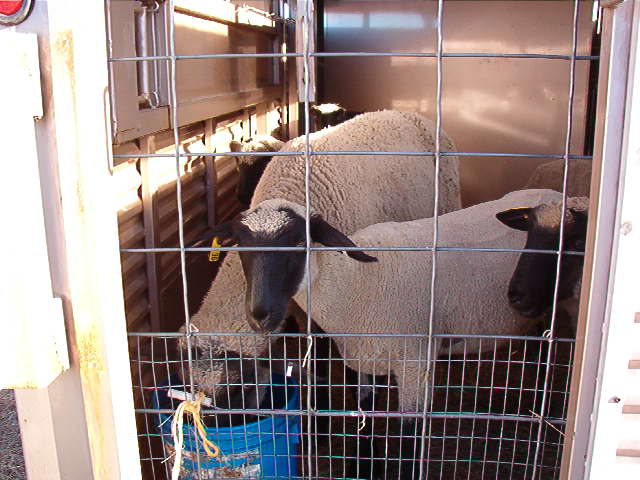
Somebody had a trailer full of Suffolk/Hampshire sheep. Others had horses, ferrets, rabbits, guineas, chickens, ducks, geese and lots of little goats, mostly pygmies.

The ugly hand of government showed up in a government vet who checked on my sheep to make sure they had that evil 'mark of the beast' government tag without which you cannot buy or sell (as mentioned in the Biblical book of Revelation). I did. An aside: I saw an article about the scrapie program which said that in ten years, the scrapie tags would eliminate scrapie. That was over ten years ago. Why are scrapie tags still required???

There was not as much activity at the sale as I would have hoped. I got to tell a number of people about Shetland sheep, and gave out two of my farm's business cards. I also met a fellow sheepman from the area, and he raises registered Katahdins! I told him about my new Katahdin ram and about how I am switching over my hair sheep flock from White Dorper to Katahdin due to the difficulty in finding herd sires within driving distance.

On the kitten front, several hopeful little boys spent the day petting and playing with some of the kittens, but Parental Units said no to taking any home. I did find a new home for a very shy but beautiful Calico kitten I thought would be the hardest to place. So it wasn't a wasted day. I do wish, however, that I'd had up-to-date farm business cards, maybe even a farm brochure as I had in years past. And some more signs, and a few more things to sell. But, there are three more sales to go, I can get better as I go along.

I also got on the mailing list for the Fur and Feather swaps, and picked up a copy of the Fall Swap schedule. There are three swaps left for the year. They are:

Saturday, Sept. 29 at Tractor Supply Company, Marinette, WI
Saturday Oct. 6 at Marinette Farm and Garden, Marinette, WI
Saturday Oct. 13 at Peshtigo Feed Mill, Peshtigo, WI

All swaps are 8 am to noon, local time. It is free for buyers and sellers, you must bring your own cages, and they are held rain or shine. Swap participants are responsible for complying with any and all government regulations involved in transporting and selling animals.

The swaps are sponsored by the Northern Poultry - Pigeon and Rabbit Club.

Friday, September 14, 2012

How NOT to Ship Worms

I recently ordered some red worms from an eBay seller. This morning I got an urgent call from my local post office--- my worms had arrived, and were escaping their package!

This is my first sight of the worm package at the post office.
After I got home with the worm package, I saw one of the escape routes.
Opening the box I found worms, living and dead, on the box flap.
There were two worms on the brown paper that was wrapped around the worm bag.
Removing the brown paper I saw many worms outside the bag and in the box. About half of these worms were dead. Since some people have this odd belief that worms are icky, I believe it's very important for worm breeders to ship in more secure containers to prevent escapes. At the very least, there should have been much more tape on the shipping box to avoid frightening the postal employees!

 Note: the worm books I mentioned in the previous post tell how to ship worms. These books are:

Raising Earthworms for Profit by Earl B. Shields

Profitable Earthworm Farming by Charlie Morgan

Wednesday, September 12, 2012

Building a Tidy Cat Worm Propagation Bin

Earthworms need homes, too. And they don't ask for much in the way of housing. This simple worm propagation bin, ideal for those who raise just a few worms for composting or fishing, is almost too easy to make.

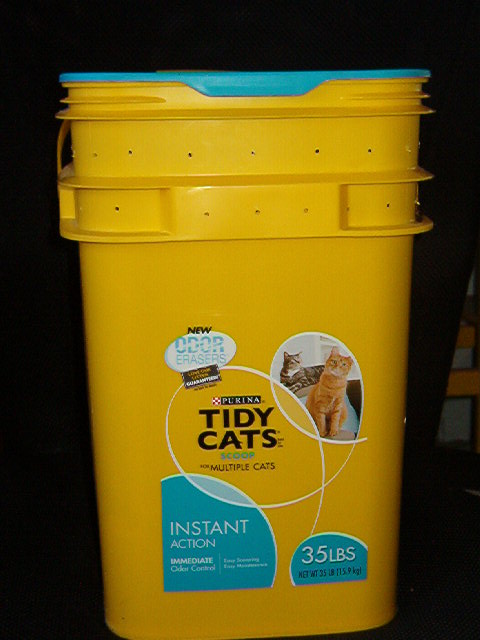
This is a cat litter pail, bought from Walmart with 35 lbs of cat litter inside. When it was empty, it became my new worm bin. This is a nice size, but I also have a somewhat smaller bin, also made from a cat litter pail, that works as well.

The first step is to drill in some air holes. In my first attempt at a cat litter pail worm bin, I drilled all the holes in the top. Not a good idea. You see, with the holes at the top, you can't stack the bins. So in this model, I drilled the air holes at the top of the pail, using a small drill bit.

Drain holes must also be drilled in the bottom of the bin. This is in case one gets too enthusiastic about wetting the worm bedding. Worms cannot live in over-wet bins, so drain holes are needed.

Bedding for worms is also their food source. One type of bedding is shredded/torn paper. Paper bedding must be soaked in water for 24 hours, then as much water wrung from it as possible. Then you fluff it out.

My paper bedding includes a lot of paper my mother shredded with her paper shredder (crosscut). It also includes hand-torn newspaper torn into about 1 inch squares.

Well composted manure is also a good worm bedding. I have loads of manure, just not so much well-composted. The composted manure must be moist. In this worm bin, I alternated layers of composted manure and damp shredded/torn paper.

Peat moss is also used in worm bedding. Commercial vermiculturalists often use 50% peat moss and 50% composted manure. Like paper, peat moss must be soaked in water for 24 hours and wrung out for use in a worm bin.

Worms for the worm bin may be obtained from a local worm farm, a bait shop, or purchased in bulk on eBay. Rule of thumb is you want about 1 lb of worms for every square foot of worm bin. Using less, it will take longer for your worms to propagate to desired levels. The type of worm you want is the red worm, or red wiggler, the common type of worm used for fishing, composting, and many other purposes.

To learn more about worm care, I recommend the book Raising Earthworms for Profit by Earl B. Shields.  I believe it is the most complete book on the subject.


Profitable Earthworm Farming by Charlie Morgan is also a fine worm manual, and it also includes a short chapter on raising mealworms.


Tuesday, September 4, 2012

The Great Comfrey Rescue

Over twenty years ago when I first started homesteading, one of my first purchases was a dozen comfrey plants. I planted them in three rows of four next to what would, in the future, be my goat barnyard. The plants did well, helped along with generous helpings of goat manure.

Comfrey plants aren't always relished by livestock at first. I've found you can encourage comfrey consumption by putting grain on top of some comfrey leaves. Once the animals get a taste of it, throwing a bunch of comfrey to your sheep and goats is like throwing a cow to hungry piranha.

My comfrey plantation did well and I had started planting some comfrey roots in a pasture section, when the comfrey plantation was wiped out by a small flock of Pilgrim geese. The plants out in the pasture did poorly due to grass competition, so later I transplanted what I could find into old tires. They were still doing poorly.

Then the other day while surfing the web, I came upon an article about things to feed one's chickens. The author says this:
"Comfrey is amazingly productive, especially if fertilized heavily (and it will take any form of fertility you throw at it, including raw chicken manure). Protein content is high (higher than alfalfa, and can if well grown be as high as soybean, dry weight basis). I cut and feed as needed, more at times in the season when the pasture is less generous. Chickens eat comfrey well. Geese love it." Read the rest of the article at the link above.
So I decided today was a good day to do a comfrey rescue--- kind of like a dog rescue but with less barking. The new comfrey plot had been kindly tilled up by my assorted poultry when their pen was in that location, and all I needed to do was use the Magic Hoe to loosen up the soil and start transplanting.

Wonder Hoe? It looks like this:

Wonder Hoe--- my second favorite tool, after the crucifix in my vampire-hunting kit.

Wonder Hoe is ready for her close-up
 So far I've transplanted two large comfrey plants, dividing it into eight smaller plants, and also planted a few tiny plants that fell off the bigger ones into a nursery row for later transplanting. The plants looked a bit pathetic due to dry conditions, but I expect them to perk right up in their new, properly cultivated bed.

Once the plants have gotten used to their new home, they will be getting little gifts from the Manure Fairy. Note: the kitty in the picture will NOT be invited to drop off any of her manure in the comfrey bed. Or I will throw Wonder Hoe in her general direction!

Thursday, August 30, 2012

Mineral Blocks can cause Salt Poisoning in Sheep

Last Sunday I went to Tractor Supply in Marinette, WI to buy some supplies. While there, I picked up a sheep mineral block.

When I set it out, I was careful to see that the sheep had plenty of water. I knew they would overdo it on the mineral block and they'd be thirsty.

The next morning, the water supply, which I thought was more than enough, was empty, and some of the sheep were showing symptoms of salt poisoning. Though I didn't know that at first, I was too busy filling all the water troughs and making sure all the sheep got a drink.

The info on the internet was grim. Salt poisoning is 50% fatal. Or more than 50% fatal, depending on which information source you read. And there isn't much to do to treat other than give them water in small amounts throughout the day--- too much water at once can be bad.

Sure enough, I lost 2 ewes that day--- including Rilla, one of my best older Dorper cross ewes, and her purebred Shetland mother, Nadezhda. Yesterday evening, I found another ewe dead.

The good news is that my most valuable Dorper cross ewe, Sarang, recovered even though she was rather badly affected.

I've decided, as a result of this experience, that my sheep get plenty enough minerals from all the weeds they eat. They don't need mineral blocks, especially if they can cause results like this in spite of precautions.

Tuesday, August 28, 2012

Ram Lambs for Sale

We currently have the following ram lambs and wether lambs (neutered ram lambs) for sale. They are not registered, but are purebred Shetland:

Ram lambs:

#360--- a twin moorit (brown) ram lamb, $115
#470--- single black krunet (krunet means 'white mark on head') ram lamb, $100


Wether lambs:
#467---- white wether lamb, $70 SOLD!
#450--- black with small horns, $70
#452--- black with larger horns, $70
Located in Menominee, MI. All sales cash only. Contact by phone 906-374-0130. We will also be having some unregistered female Shetland sheep for sale.

Craigslist Ad for these sheep